Tips for Teaming: The Unexpected Link Between Nike, Adidas, Vans and Red Bull, and Why It Matters for Your Team’s Innovation
The unexpected link between Nike, Adidas, Vans and Red Bull has nothing to do with products and everything to do with how they innovate. They each took an existing idea and reframed it for a different audience, and teams can do exactly the same. My latest article explores how Lightning Demos and AI help teams gather inspiration from outside their own industry and turn it into clear, practical solutions. If your team wants to innovate with more confidence and less friction, this will be a useful read.
TIPSFORTEAMINGINNOVATIONAIDESIGN SPRINT
12/1/20255 min read


When people talk about innovation, there is often an assertion that it must come from a completely original idea. Believe it or not, this is not true. For instance, if I ask you what Nike, Adidas, Vans and Red Bull have in common, the answer reveals something essential about how innovative organisations actually succeed.
Nike and Adidas built their early identity around mainstream sports. They aligned their message with footballers, basketball players and classic athletic performance. Years later, brands such as Vans and Red Bull followed a very similar principle. Vans chose the skating community. Red Bull chose extreme sports. They selected a specific audience linked to a specific type of sport and invested heavily in that space. They did not need an idea that had never existed. They repurposed a principle that was already successful in another context and expressed it in their own distinctive way.
This shows something important. Innovation is not only about creating something entirely unprecedented. It is often about reframing, redirecting and recombining existing ideas. Teams can make significant progress through inspiration from outside their own walls.
This is why I value the Design Sprint methodology so much. One of its core steps is the Lightning Demo. The Lightning Demo invites teams to look outside their current part of the organisation, even outside the organisation, and examine how others have solved similar problems. It encourages searching across industries and learning from approaches that have already delivered results elsewhere when similar challenges appeared. The goal is to collect concrete, real-world examples that can be repurposed, adapted and shaped into solutions that make sense for the challenge at hand. Innovation becomes a process of deliberate inspiration rather than isolated invention.
Get your team inspired with a Lightning Demo
Here is how you can run a simple, effective Lightning Demo with your team:
Practical Steps to Run a Lightning Demo
Define your challenge. Formulate it clearly, ideally as a “How might we…” question. For example: “How might we improve our first-time user onboarding?” And you might decide to focus on the landing page the user sees first.
Ask each participant to research three examples from other companies (in any industry) that have solved a similar challenge or achieved a related outcome. Encourage thinking broadly: apps, services, products, physical services, digital platforms, anything.
Give each team member a few minutes (e.g. 3–5 minutes) to present their examples and explain why they think they are interesting. Encourage focusing on the core “big idea” behind each example, not on details.
As each example is presented, someone is capturing the “big idea” on a shared board (post-its, whiteboard, virtual board, etc.), with a brief note or headline summarising the insight. Tip: choose the note taker before. If you have a facilitator running the session they could do that and leave the rest of the team to be fully immersed in listening to the ideas.
Once all presentations are done, the team reviews the collected ideas, and selects (e.g. by voting or discussion) those that feel most promising to adapt to the current challenge. These selected ideas become your “innovation ingredients” for the next phase — sketching or prototyping.
Examples of Lightning Demo
Example: Improving user onboarding
Remind the team about the challenge: How might we improve user onboarding so that first-time users feel guided, confident and successful within the first five minutes.
To make the exercise practical, the team decides to focus on one specific part of the journey: the landing page that users see when they try the service for the first time. The group will look for landing page experiences from any industry that create clarity, motivation and ease.
Lighting Demo Inspiring Company: Duolingo
Big idea: Create a feeling of quick progress through micro-steps
Useful elements to reuse:
Break the onboarding into very small, achievable actions that take seconds.
Reward early progress visually to build momentum.
Offer an immediate first action so the user feels they are already succeeding.
Example: Designing an AI-assisted help experience
How might we design an AI-assisted help experience that allows users to find information quickly, intuitively and without frustration.
To keep the Lightning Demo focused, the team looks specifically for products that simplify complex writing or search tasks through clear AI actions and guidance.
Lighting Demo Inspiring Company: Google Docs with Gemini (Help me write)
Big idea: Guide users towards better requests through visible AI actions and simple refinements
Useful elements to reuse:
The interface provides a clear entry point, “Help me write”, which shows users exactly where to begin when they need support.
After generating text, the system offers straightforward refinement options such as summarise, expand, shorten or adjust tone, which helps users understand what the AI can do next.
The AI works directly on the content the user has selected, which removes friction and allows people to ask for improvements without starting from zero.
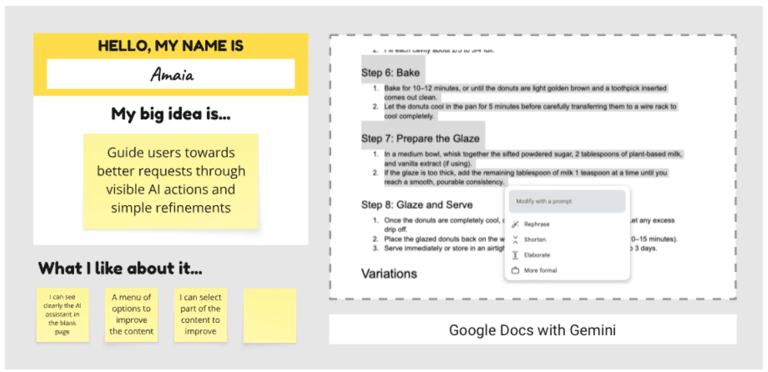
Example of a lightning demo in a digital board
This exercise generates concrete, actionable inspiration, not a vague “pattern”, but actual design ideas they could prototype and test quickly. The Lightning Demo fuels a team's solution sketching and ultimately shape an MVP.
How to Use AI to Strengthen Your Lightning Demo
GenAI tools can accelerate the “research for inspiring examples” phase dramatically. For example you might use a prompt like:
We are exploring the challenge: “How might we [INSERT YOUR CHALLENGE].” Search across sectors to identify five examples where organisations have solved a similar type of problem. For each example, extract the underlying pattern and present a Lightning Demo: start with the big idea, then list two specific elements that make the approach effective."
With this prompt, AI can surface examples from sectors you may not naturally consider, retail, edtech, fintech, healthcare, and bring fresh inspiration to the team. You can then bring those ideas into your Lightning Demo session, present them, discuss them and see which ones could be adapted to your own problem. The team remains in control of deciding which ideas to pursue while benefitting from a broader field of inspiration.
A final reflection: Lightning Demos work because they are a team sport
The real power of a Lightning Demo is not the individual research. It is what happens when the team comes together. Each person goes out into the world, collects inspiration from different industries and perspectives, and brings those insights back into the room. When these ideas are shared openly, the team builds a shared understanding of what is possible. When the group selects the most promising ideas as a collective, motivation rises because the direction feels co-created rather than imposed. Innovation does not come from one person having a breakthrough. It comes from many people contributing diverse ideas and then shaping them into a single, unified solution. This collaborative process strengthens ownership, accelerates decision-making and helps teams feel more energised about the path ahead.
Conversation Starter for Your Team
Next time you and your team face a challenge, ask:
“Which companies outside our industry solve a version of this problem in a way that we admire?”
That single question can shift thinking dramatically.
Greater impact, better results, healthier teams in tech-driven organisations
amaia@amaialesta.com
© 2026. All rights reserved.