Tips for Teaming: The Question That Helps Teams Think Bigger (and Smarter)
What if the thing your team is missing is simply space to dream big again?
Amaia Lesta
12/23/20252 min read
As we close this year, I want to share a question that has quietly become one of my favourites when working with leaders and teams.
Every time I ask it, I see something change.
People pause. Faces soften. Energy shifts.
There is relief, curiosity, and often a spark of excitement.
The question is this:
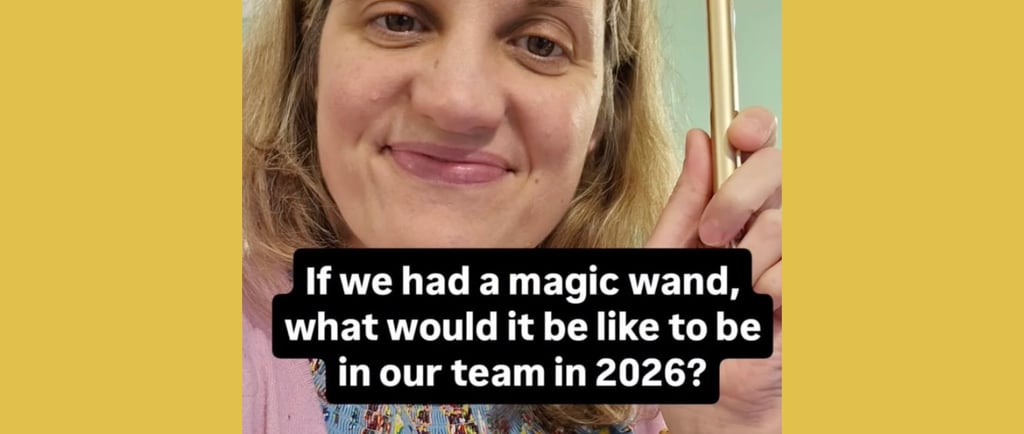
🪄 If we had a magic wand, what would it be like to be in our team in 2026?
You can use it as in one to one too when facing a situation you wish was different
🪄 If you/I had a magic wand, what would it be like ...?
Why this question works
From a coaching, psychology, and neuroscience perspective, this kind of question is powerful for a reason.
Future-focused, possibility-based questions activate very different thinking from problem-focused ones. Instead of narrowing attention around constraints, risks, and urgency, they invite people into reflection, creativity, and meaning.
Research from solution-focused coaching and appreciative inquiry shows that imagining a desired future helps individuals and teams:
Access broader and more creative thinking
Reconnect with intrinsic motivation
Feel greater ownership of change
From a neuroscience perspective, imagining future states engages networks linked to reflection and sense-making, rather than stress-driven task execution.
In simple terms: this question helps people step out of survival mode and into design mode.
Why it matters for teams in tech right now
Many teams I work with are capable, committed, and technically strong.
Yet they are tired.
Not because they lack ambition.
Because they rarely get the space to step back and ask what they are truly trying to create together.
This question shifts the conversation:
From delivery pressure → to shared intention
From reacting → to designing
From individual coping → to collective direction
It helps teams reconnect with why they exist as a team, not just what they need to deliver next.
Dreaming bigger does not mean being unrealistic
One concern leaders sometimes raise is whether this kind of question is “too idealistic”.
The evidence suggests the opposite.
Research on goal clarity, motivation, and team effectiveness consistently shows that when people hold a compelling picture of a desired future, they make better day-to-day decisions.
The magic wand question does not remove constraints.
It temporarily suspends them.
That short pause is often enough to surface:
What truly matters
What people are missing
What is no longer sustainable
What the team wants to protect or strengthen
From there, practical priorities become clearer, not vaguer.
How I use this question in practice
When I ask this in team sessions, I do not rush to action.
I invite people to describe:
How it feels to be in the team
How decisions are made
How conflict is handled
How success is experienced
How energy flows during the week
Only later do we connect those insights to concrete actions, ways of working, or priorities.
That is where meaningful change starts.
A closing reflection for the end of the year
As we head towards 2026, I invite you to ask this question of yourself and your team:
🪄 If we had a magic wand, what would it be like to be in our team in 2026?
Listen carefully.
The answers often contain more clarity than any roadmap.
Sometimes, the most powerful tool a leader can use is not another framework or plan.
It is a well-timed question.
Team well = Greater impact, better results, healthier tech teams
PS: The “magic wand” in the photos is my facilitation clicker. A small thing, yet a game-changer for staying present and in flow during sessions. Sometimes, the simplest tools make a bigger difference than we expect.
Greater impact, better results, healthier teams in tech-driven organisations
amaia@amaialesta.com
© 2026. All rights reserved.